How to calculate your salary after tax
Your offer letter says $65,000. Your bank account sees something smaller. Here is exactly what comes out of a US paycheck, in what order, and how to work out your own number in about two minutes.
By the ToolSnappy Team · Updated · 8 min read
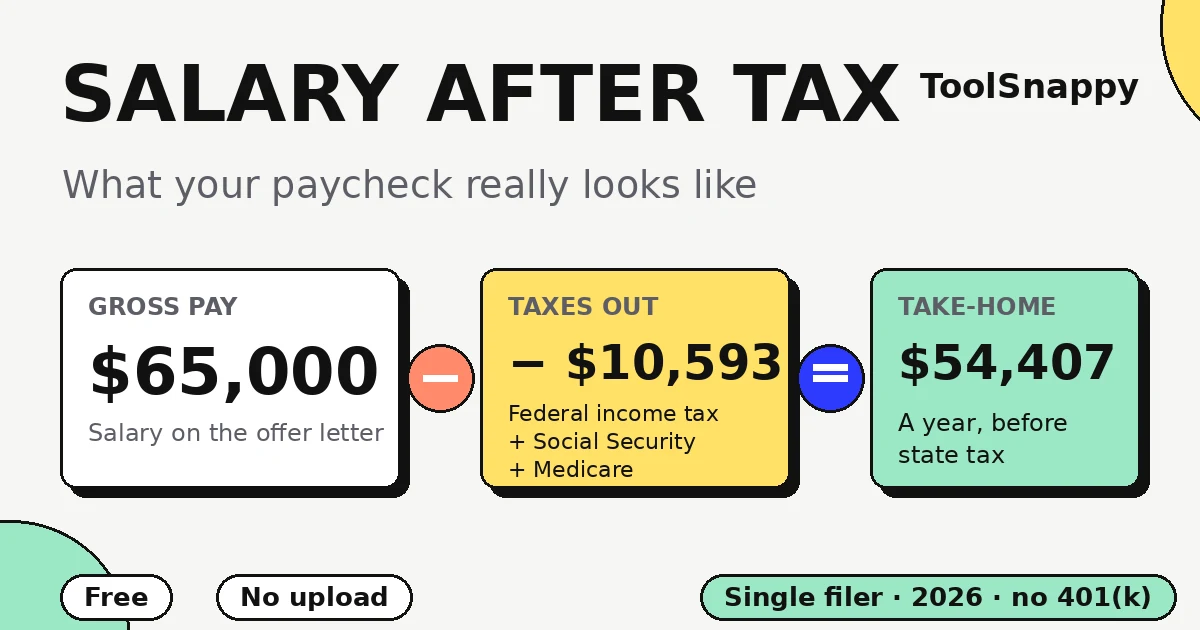
Nobody gets paid their salary. You get paid what is left of it after the deductions come out, and the gap between the number on the offer letter and the number in your bank account surprises almost everyone the first time they see it. A $65,000 salary is not $5,417 a month. After federal tax, Social Security, Medicare and state tax, it is closer to $4,400 — and that is before health insurance or a 401(k).
The good news is that the maths is not mysterious. Five things come out of a paycheck, always in the same order, and once you know them you can work out any salary in a couple of minutes. The steps below use the Take-Home Pay Calculator on this site, which runs entirely in your browser. After the method, there is a worked example you can check against your own pay stub.
1. The short answer: five things come out, in this order
Every US paycheck runs the same gauntlet. Gross pay goes in at the top, and what survives is your take-home pay:
- Pre-tax deductions — a traditional 401(k) and health insurance premiums come out first, before any tax is calculated.
- Federal income tax — worked out on what is left, after the standard deduction.
- Social Security tax — 6.2% of wages, up to a yearly cap.
- Medicare tax — 1.45% of all wages, plus a little extra at high incomes.
- State income tax — whatever your state charges, if it charges anything.
The order matters, because each step changes the number the next step works on. A 401(k) contribution lowers your federal income tax, for instance, because the tax is calculated after the contribution comes out. It does not lower Social Security or Medicare, which are charged on the money anyway. That one detail explains half the surprises on a first pay stub.
2. Start with gross pay: salary or hourly
Gross pay is the number before anything comes out. If you are salaried, it is the number on the offer letter. If you are paid hourly, multiply it out: hourly rate × hours per week × 52 weeks. A full-time year is usually counted as 2,080 hours — 40 hours a week for 52 weeks — so $31.25 an hour is $65,000 a year, and $25 an hour is $52,000.
Overtime, bonuses and commissions count as wages too, and they are taxed in the year you receive them. A bonus does not get its own special rate — it is added to your income for the year — though your employer may withhold from it at a flat 22% for federal tax, which is often more than your normal rate and is settled up when you file.
3. Subtract pre-tax deductions first
Before any tax is worked out, two common deductions come off the top. A traditional 401(k) contribution reduces the income your federal tax is calculated on — put in 5% of a $65,000 salary ($3,250) and your taxable income drops by the same $3,250. Health insurance premiums paid through your employer work the same way. For 2026, the most you can put into a 401(k) is $24,500.
What does not reduce your tax this way: Roth 401(k) contributions, which are taxed now and withdrawn tax-free later, and after-tax deductions like a gym membership or a parking pass. And remember the split from section 1 — 401(k) money still counts for Social Security and Medicare. The IRS is clear on this, and it is the reason a 401(k) saves you income tax but never shows up as a smaller FICA line.
4. Federal income tax: the standard deduction, then the brackets
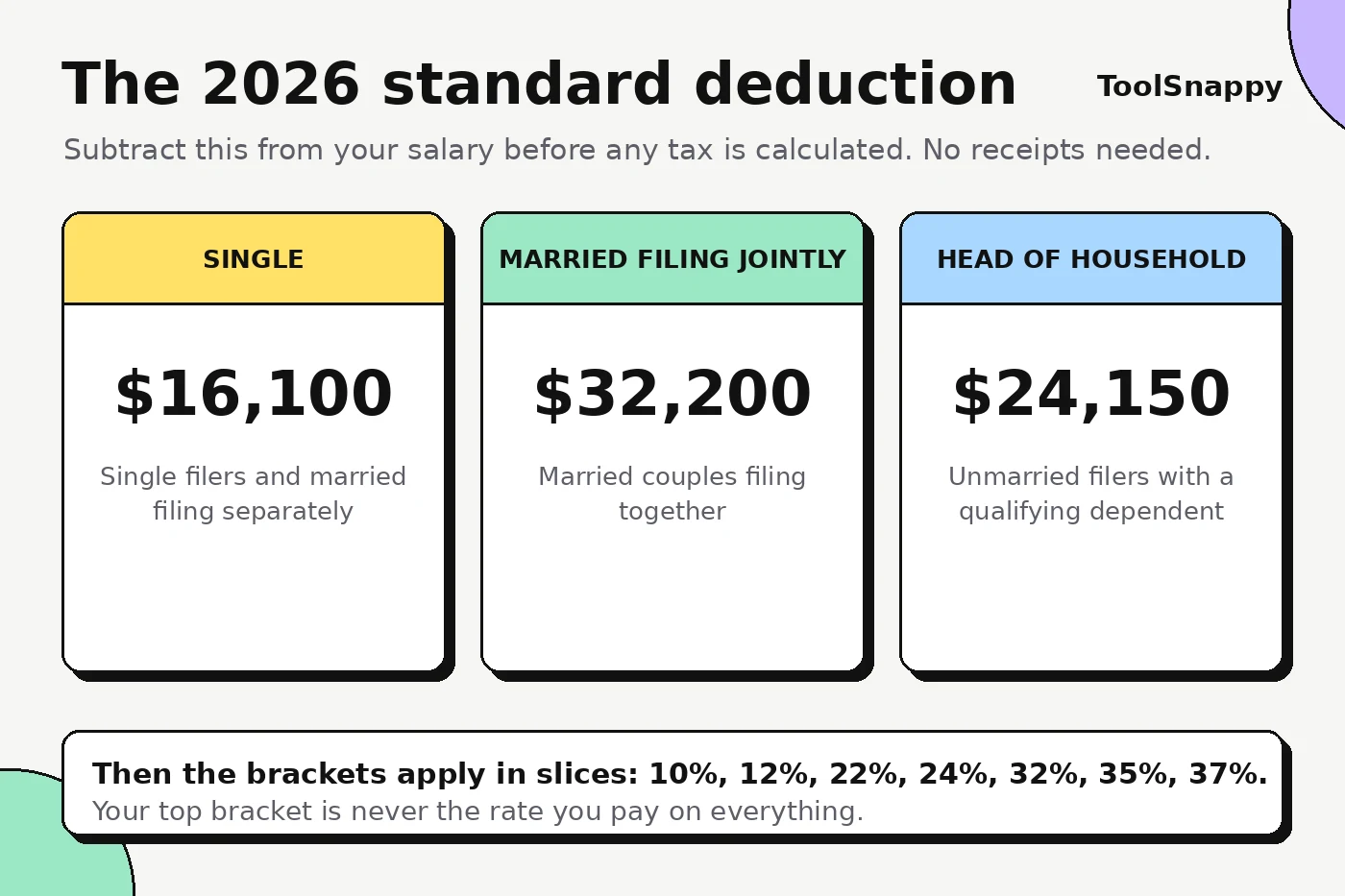
Federal income tax is not charged on your whole salary. First comes the standard deduction — a flat amount the IRS lets everyone subtract before tax starts. For 2026 it is $16,100 for single filers, $32,200 for married couples filing jointly, and $24,150 for heads of household. Only what is left after that, and after pre-tax deductions, is taxable income.
Then the brackets apply, and this is where most people go wrong. The US has seven rates — 10%, 12%, 22%, 24%, 32%, 35% and 37% — but they apply in slices, not to the whole amount. Being “in the 22% bracket” does not mean you pay 22% on everything. It means the last slice of your income is taxed at 22%, while the earlier slices are taxed at 10% and 12%. Your effective rate — the tax divided by your income — is always lower than your top bracket.
| Step | Amount | Running total |
|---|---|---|
| Gross salary | $65,000 | $65,000 |
| Standard deduction (single, 2026) | − $16,100 | $48,900 taxable |
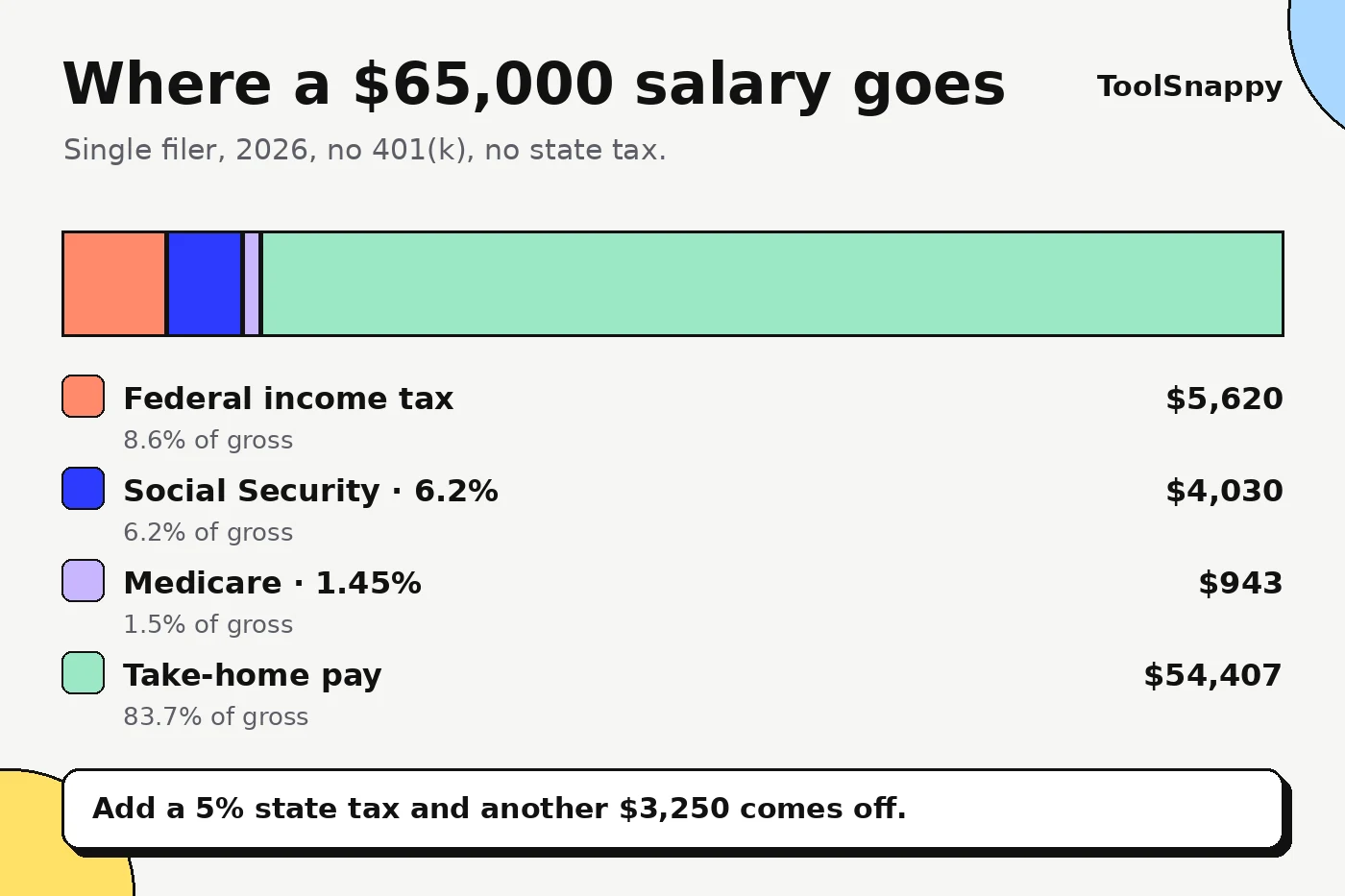
| Federal income tax on $48,900 | 10% on the first slice, 12% on the rest | $5,620 |
| Social Security: 6.2% of $65,000 | $4,030 | |
| Medicare: 1.45% of $65,000 | $943 | |
| Total tax before state tax | $10,593 | |
| Take-home pay (no 401(k), no state tax) | $54,407 a year |
That $54,407 a year is about $4,534 a month, or $2,092 every two weeks. Add a state tax — say 5% — and another $3,250 comes off, leaving roughly $51,150 a year. Add a 5% 401(k) contribution and the federal tax falls, because the taxable income drops to $45,650 — but the take-home also falls by the $3,250 you chose to save. Saving is still saving; it just does not feel like a pay rise.
5. Social Security and Medicare: the flat rates with a cap
These two are simpler than federal income tax, because the rates are flat. Social Security takes 6.2% of your wages — but only up to $184,500 in 2026. Earn more than that and the deduction stops for the rest of the year, which is why high earners sometimes notice a bigger paycheck in the autumn. The most any employee pays in Social Security tax in 2026 is $11,439. Your employer pays the same amount again on your behalf.
Medicare takes 1.45% of every dollar, with no cap at all. On top of that, single filers pay an extra 0.9% on wages above $200,000 (married couples filing jointly: above $250,000). Together, Social Security and Medicare are the FICA taxes on your pay stub, and unlike federal income tax they do not shrink when you contribute to a 401(k).
6. State tax: the part that varies most
State income tax is where two identical salaries can produce very different paychecks. Some states charge a flat rate, some use their own brackets, and nine states charge no income tax on regular wages at all: Alaska, Florida, Nevada, New Hampshire, South Dakota, Tennessee, Texas, Washington and Wyoming. The calculator on this site asks for a flat state rate, which is a fair approximation for most people — but if your state has brackets of its own, or your city adds a local tax, treat the result as an estimate and check your state’s own tables.
One more wrinkle: if you live in one state and work in another, both may want a say. Most states give you a credit for tax paid to the other state, so you are rarely taxed twice on the same dollar — but the paperwork is real, and it is the most common reason a move across a state line produces a surprise in April.
7. Turn the yearly number into a paycheck
Your employer does not pay you the yearly figure. It divides it by how often you are paid, and the per-paycheck number is the one that actually matters for rent and groceries:
| Pay frequency | Paychecks a year | Take-home per check |
|---|---|---|
| Weekly | 52 | About $1,046 |
| Every two weeks | 26 | About $2,092 |
| Twice a month | 24 | About $2,267 |
| Monthly | 12 | About $4,534 |
If your real paycheck does not match the maths, check three things before assuming an error. First, your W-4: the form you filled in when you were hired tells your employer how much to withhold, and an old W-4 — from before a marriage, a child, or a second job — withholds the wrong amount. Second, your pre-tax deductions: a health premium or 401(k) change moves the number without changing your salary. Third, the pay period itself: a three-paycheck month looks like a windfall on a biweekly schedule, but the yearly total is the same.
The IRS has its own free Tax Withholding Estimator, which takes about 25 minutes and tells you whether to change your W-4. It is the right next step if the calculator says one thing and your pay stub says another — and it is free, with no login and no personal information stored.
Frequently asked questions
How do I calculate my salary after tax?
Start with gross pay, subtract pre-tax deductions like a 401(k) and health premiums, then subtract the standard deduction ($16,100 single, $32,200 married filing jointly in 2026). Work out federal income tax on what is left using the brackets, then subtract Social Security (6.2% up to $184,500) and Medicare (1.45%), plus state tax. The remainder is your take-home pay. The salary calculator on this page does the same steps for you.
Why is my take-home pay less than my salary divided by 26?
Because dividing by 26 gives you gross pay per biweekly check, before anything comes out. Federal income tax, Social Security, Medicare, state tax and any pre-tax deductions all come off first. On a $65,000 salary, single, with no state tax, the biweekly gross is $2,500 but the take-home is about $2,092.
Does a 401(k) lower my taxes?
It lowers your federal income tax, because the contribution comes out before that tax is calculated — but it does not lower Social Security or Medicare tax, which are charged on the money anyway. For 2026 you can contribute up to $24,500 to a 401(k). A Roth 401(k) is the opposite: taxed now, withdrawn tax-free later.
Do I pay Social Security tax on my whole salary?
Only up to $184,500 in 2026. Social Security tax is 6.2% of wages up to that cap, so the most you pay in a year is $11,439. Above the cap the deduction stops until January. Medicare has no cap: the 1.45% applies to every dollar, plus an extra 0.9% on wages above $200,000 for single filers.
Sources
- IRS — Tax Withholding Estimator
- Social Security Administration — Contribution and Benefit Base
- IRS — Updated Tax Withholding Estimator (IR-2026-35)
This guide is for general information and isn’t financial, tax, legal or medical advice. Figures were checked against the sources above on the date shown.